143.重排链表
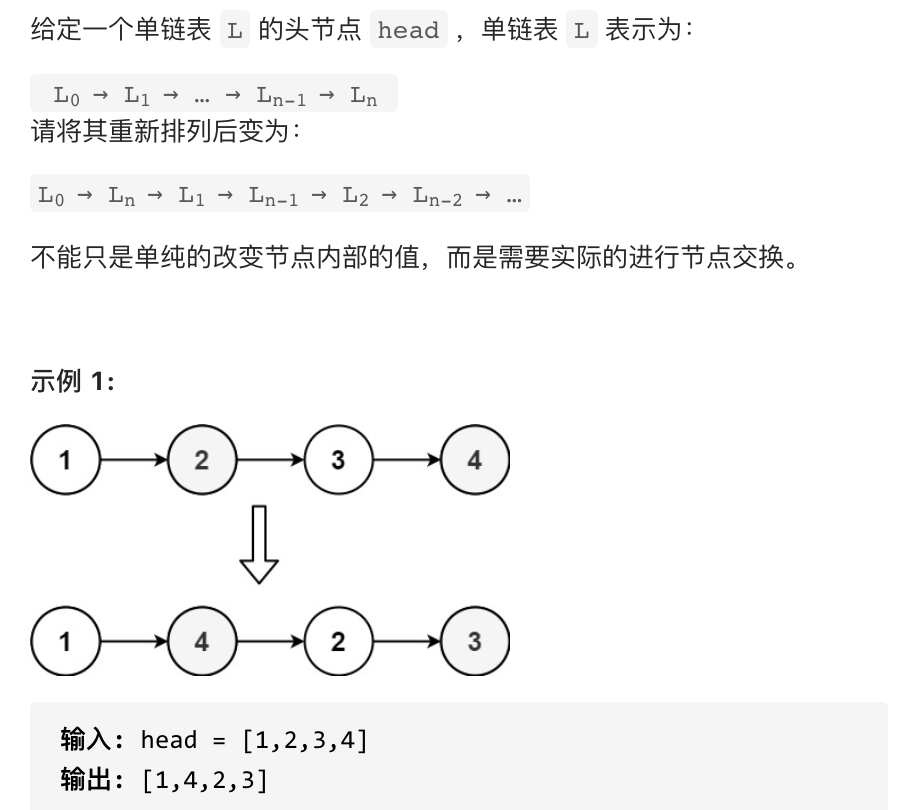
思路
本篇将给出三种C++实现的方法
- 数组模拟
- 双向队列模拟
- 直接分割链表
方法一
把链表放进数组中,然后通过双指针法,一前一后,来遍历数组,构造链表。
代码如下:
class Solution {
public:
    void reorderList(ListNode* head) {
        vector<ListNode*> vec;
        ListNode* cur = head;
        if (cur == nullptr) return;
        while(cur != nullptr) {
            vec.push_back(cur);
            cur = cur->next;
        }
        cur = head;
        int i = 1;
        int j = vec.size() - 1;  // i j为之前前后的双指针
        int count = 0; // 计数,偶数取后面,奇数取前面
        while (i <= j) {
            if (count % 2 == 0) {
                cur->next = vec[j];
                j--;
            } else {
                cur->next = vec[i];
                i++;
            }
            cur = cur->next;
            count++;
        }
        cur->next = nullptr; // 注意结尾
    }
};
方法二
把链表放进双向队列,然后通过双向队列一前一后弹出数据,来构造新的链表。这种方法比操作数组容易一些,不用双指针模拟一前一后了
class Solution {
public:
    void reorderList(ListNode* head) {
        deque<ListNode*> que;
        ListNode* cur = head;
        if (cur == nullptr) return;

        while(cur->next != nullptr) {
            que.push_back(cur->next);
            cur = cur->next;
        }

        cur = head;
        int count = 0; // 计数,偶数取后面,奇数取前面
        ListNode* node;
        while(que.size()) {
            if (count % 2 == 0) {
                node = que.back();
                que.pop_back();
            } else {
                node = que.front();
                que.pop_front();
            }
            count++;
            cur->next = node;
            cur = cur->next;
        }
        cur->next = nullptr; // 注意结尾
    }
};
方法三
将链表分割成两个链表,然后把第二个链表反转,之后在通过两个链表拼接成新的链表。
如图:
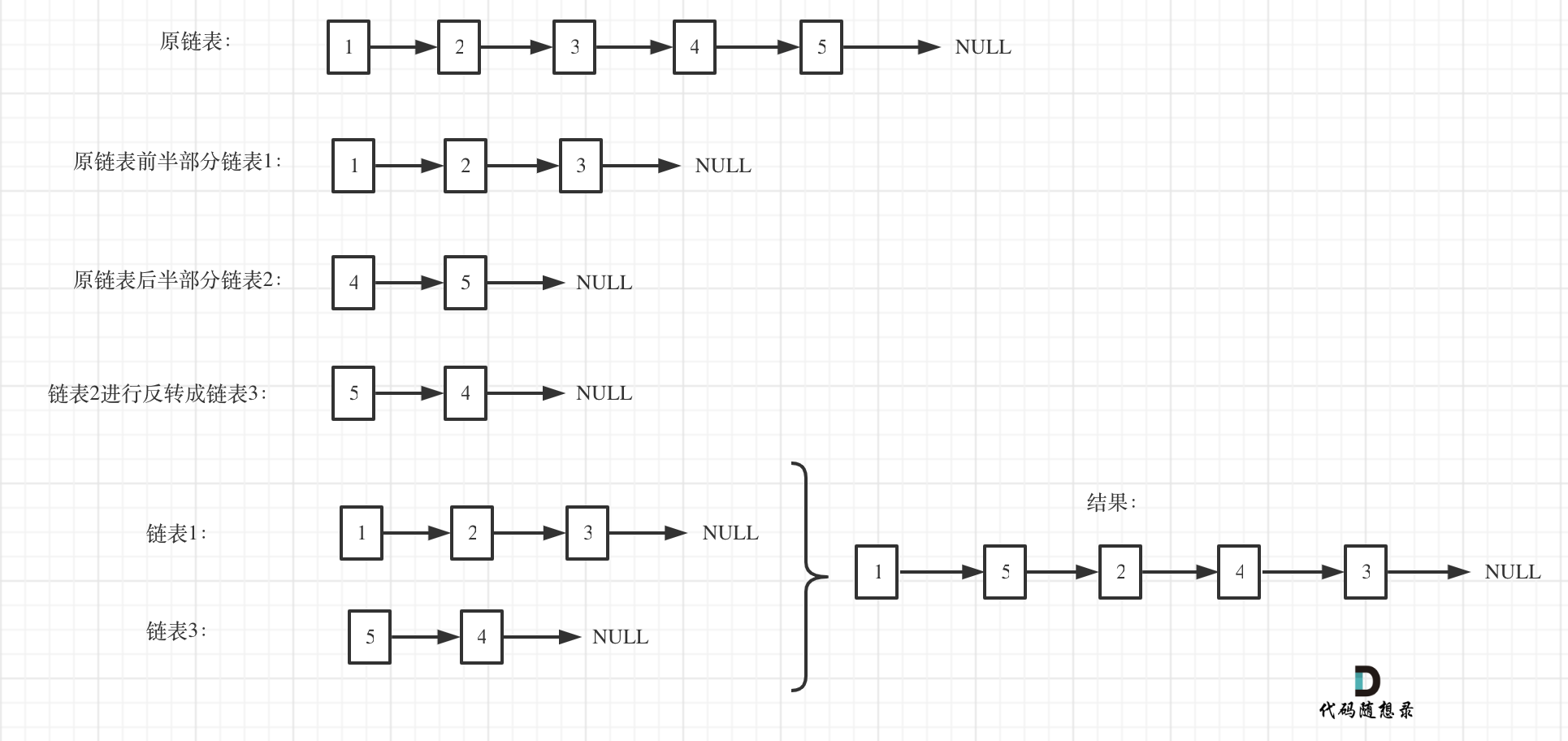
这种方法,比较难,平均切割链表,看上去很简单,真正代码写的时候有很多细节,同时两个链表最后拼装整一个新的链表也有一些细节需要注意!
代码如下:
class Solution {
private:
    // 反转链表
    ListNode* reverseList(ListNode* head) {
        ListNode* temp; // 保存cur的下一个节点
        ListNode* cur = head;
        ListNode* pre = NULL;
        while(cur) {
            temp = cur->next;  // 保存一下 cur的下一个节点,因为接下来要改变cur->next
            cur->next = pre; // 翻转操作
            // 更新pre 和 cur指针
            pre = cur;
            cur = temp;
        }
        return pre;
    }

public:
    void reorderList(ListNode* head) {
        if (head == nullptr) return;
        // 使用快慢指针法,将链表分成长度均等的两个链表head1和head2
        // 如果总链表长度为奇数,则head1相对head2多一个节点
        ListNode* fast = head;
        ListNode* slow = head;
        while (fast && fast->next && fast->next->next) {
            fast = fast->next->next;
            slow = slow->next;
        }
        ListNode* head1 = head;
        ListNode* head2;
        head2 = slow->next;
        slow->next = nullptr;

        // 对head2进行翻转
        head2 = reverseList(head2);

        // 将head1和head2交替生成新的链表head
        ListNode* cur1 = head1;
        ListNode* cur2 = head2;
        ListNode* cur = head;
        cur1 = cur1->next;
        int count = 0; // 偶数取head2的元素,奇数取head1的元素
        while (cur1 && cur2) {
            if (count % 2 == 0) {
                cur->next = cur2;
                cur2 = cur2->next;
            } else {
                cur->next = cur1;
                cur1 = cur1->next;
            }
            count++;
            cur = cur->next;
        }
        if (cur2 != nullptr) { // 处理结尾
            cur->next = cur2;
        }
        if (cur1 != nullptr) {
            cur->next = cur1;
        }
    }
};
其他语言版本
- Java
- Python
- Go
- JavaScript
- TypeScript
- C
// 方法一 Java实现,使用数组存储节点
 class Solution {
    public void reorderList(ListNode head) {
        // 双指针的做法
        ListNode cur = head;
        // ArrayList底层是数组,可以使用下标随机访问
        List<ListNode> list = new ArrayList<>();
        while (cur != null){
            list.add(cur);
            cur = cur.next;
        }
        cur = head;  // 重新回到头部
        int l = 1, r = list.size() - 1;  // 注意左边是从1开始
        int count = 0;
        while (l <= r){
            if (count % 2 == 0){
                // 偶数
                cur.next = list.get(r);
                r--;
            }else {
                // 奇数
                cur.next = list.get(l);
                l++;
            }
            // 每一次指针都需要移动
            cur = cur.next;
            count++;
        }
        // 注意结尾要结束一波
        cur.next = null;
    }
}
// 方法二:使用双端队列,简化了数组的操作,代码相对于前者更简洁(避免一些边界条件)
class Solution {
    public void reorderList(ListNode head) {
        // 使用双端队列的方法来解决
        Deque<ListNode> de = new LinkedList<>();
        // 这里是取head的下一个节点,head不需要再入队了,避免造成重复
        ListNode cur = head.next;
        while (cur != null){
            de.offer(cur);
            cur = cur.next;
        }
        cur = head;  // 回到头部

        int count = 0;
        while (!de.isEmpty()){
            if (count % 2 == 0){
                // 偶数,取出队列右边尾部的值
                cur.next = de.pollLast();
            }else {
                // 奇数,取出队列左边头部的值
                cur.next = de.poll();
            }
            cur  = cur.next;
            count++;
        }
        cur.next = null;
    }
}

// 方法三
public class ReorderList {
    public void reorderList(ListNode head) {
        ListNode fast = head, slow = head;
        //求出中点
        while (fast.next != null && fast.next.next != null) {
            slow = slow.next;
            fast = fast.next.next;
        }
        //right就是右半部分 12345 就是45  1234 就是34
        ListNode right = slow.next;
        //断开左部分和右部分
        slow.next = null;
        //反转右部分 right就是反转后右部分的起点
        right = reverseList(right);
        //左部分的起点
        ListNode left = head;
        //进行左右部分来回连接
        //这里左部分的节点个数一定大于等于右部分的节点个数 因此只判断right即可
        while (right != null) {
            ListNode curLeft = left.next;
            left.next = right;
            left = curLeft;

            ListNode curRight = right.next;
            right.next = left;
            right = curRight;
        }
    }

    public ListNode reverseList(ListNode head) {
        ListNode headNode = new ListNode(0);
        ListNode cur = head;
        ListNode next = null;
        while (cur != null) {
            next = cur.next;
            cur.next = headNode.next;
            headNode.next = cur;
            cur = next;
        }
        return headNode.next;
    }
}
# 方法二 双向队列
class Solution:
    def reorderList(self, head: ListNode) -> None:
        """
        Do not return anything, modify head in-place instead.
        """
        d = collections.deque()
        tmp = head
        while tmp.next: # 链表除了首元素全部加入双向队列
            d.append(tmp.next)
            tmp = tmp.next
        tmp = head
        while len(d): # 一后一前加入链表
            tmp.next = d.pop()
            tmp = tmp.next
            if len(d):
                tmp.next = d.popleft()
                tmp = tmp.next
        tmp.next = None # 尾部置空

# 方法三 反转链表
class Solution:
    def reorderList(self, head: ListNode) -> None:
        if head == None or head.next == None:
            return True
        slow, fast = head, head
        while fast and fast.next:
            slow = slow.next
            fast = fast.next.next
        right = slow.next # 分割右半边
        slow.next = None # 切断
        right = self.reverseList(right) #反转右半边
        left = head
        # 左半边一定比右半边长, 因此判断右半边即可
        while right:
            curLeft = left.next
            left.next = right
            left = curLeft

            curRight = right.next
            right.next = left
            right = curRight

    def reverseList(self, head: ListNode) -> ListNode:
        cur = head
        pre = None
        while(cur!=None):
            temp = cur.next # 保存一下cur的下一个节点
            cur.next = pre # 反转
            pre = cur
            cur = temp
        return pre
// 方法一 数组模拟
/**
 * Definition for singly-linked list.
 * type ListNode struct {
 *     Val int
 *     Next *ListNode
 * }
 */
func reorderList(head *ListNode)  {
    vec := make([]*ListNode, 0)
    cur := head
    if cur == nil {
        return
    }
    for cur != nil {
        vec = append(vec, cur)
        cur = cur.Next
    }
    cur = head
    i := 1
    j := len(vec) - 1  // i j为前后的双指针
    count := 0   // 计数,偶数取后面,奇数取前面
    for i <= j {
        if count % 2 == 0 {
            cur.Next = vec[j]
            j--
        } else {
            cur.Next = vec[i]
            i++
        }
        cur = cur.Next
        count++
    }
    cur.Next = nil // 注意结尾
}
// 方法二 双向队列模拟
/**
 * Definition for singly-linked list.
 * type ListNode struct {
 *     Val int
 *     Next *ListNode
 * }
 */
func reorderList(head *ListNode)  {
    que := make([]*ListNode, 0)
    cur := head
    if cur == nil {
        return
    }

    for cur.Next != nil {
        que = append(que, cur.Next)
        cur = cur.Next
    }

    cur = head
    count := 0 // 计数,偶数取后面,奇数取前面
    for len(que) > 0 {
        if count % 2 == 0 {
            cur.Next = que[len(que)-1]
            que = que[:len(que)-1]
        } else {
            cur.Next = que[0]
            que = que[1:]
        }
        count++
        cur = cur.Next
    }
    cur.Next = nil // 注意结尾
}
// 方法三 分割链表
func reorderList(head *ListNode)  {
    var slow=head
    var fast=head
    for fast!=nil&&fast.Next!=nil{
        slow=slow.Next
        fast=fast.Next.Next
    }  //双指针将链表分为左右两部分
    var right =new(ListNode)
    for slow!=nil{
        temp:=slow.Next
        slow.Next=right.Next
        right.Next=slow
        slow=temp
    }  //翻转链表右半部分
    right=right.Next  //right为反转后得右半部分
    h:=head
    for right.Next!=nil{
        temp:=right.Next
        right.Next=h.Next
        h.Next=right
        h=h.Next.Next
        right=temp
    } //将左右两部分重新组合
}
// 方法一 使用数组存储节点
var reorderList = function(head, s = [], tmp) {
    let cur = head;
    // list是数组,可以使用下标随机访问
    const list = [];
    while(cur != null){
        list.push(cur);
        cur = cur.next;
    }
    cur = head; // 重新回到头部
    let l = 1, r = list.length - 1; // 注意左边是从1开始
    let count = 0;
    while(l <= r){
        if(count % 2 == 0){
            // even
            cur.next = list[r];
            r--;
        } else {
            // odd
            cur.next = list[l];
            l++;
        }
        // 每一次指针都需要移动
        cur = cur.next;
        count++;
    }
    // 注意结尾要结束一波
    cur.next = null;
}

// 方法二 使用双端队列的方法来解决 js中运行很慢
var reorderList = function(head, s = [], tmp) {
    // js数组作为双端队列
    const deque = [];
    // 这里是取head的下一个节点,head不需要再入队了,避免造成重复
    let cur = head.next;
    while(cur != null){
        deque.push(cur);
        cur = cur.next;
    }
    cur = head;  // 回到头部
    let count = 0;
    while(deque.length !== 0){
        if(count % 2 == 0){
            // even,取出队列右边尾部的值
            cur.next = deque.pop();
        } else {
            // odd, 取出队列左边头部的值
            cur.next = deque.shift();
        }
        cur = cur.next;
        count++;
    }
    cur.next = null;
}

//方法三 将链表分割成两个链表,然后把第二个链表反转,之后在通过两个链表拼接成新的链表
var reorderList = function(head, s = [], tmp) {
    const reverseList = head => {
        let headNode = new ListNode(0);
        let cur = head;
        let next = null;
        while(cur != null){
            next = cur.next;
            cur.next = headNode.next;
            headNode.next = cur;
            cur = next;
        }
        return headNode.next;
    }

    let fast = head, slow = head;
    //求出中点
    while(fast.next != null && fast.next.next != null){
        slow = slow.next;
        fast = fast.next.next;
    }
    //right就是右半部分 12345 就是45  1234 就是34
    let right = slow.next;
    //断开左部分和右部分
    slow.next = null;
    //反转右部分 right就是反转后右部分的起点
    right = reverseList(right);
    //左部分的起点
    let left = head;
    //进行左右部分来回连接
    //这里左部分的节点个数一定大于等于右部分的节点个数 因此只判断right即可
    while (right != null) {
        let curLeft = left.next;
        left.next = right;
        left = curLeft;

        let curRight = right.next;
        right.next = left;
        right = curRight;
    }
}
辅助数组法:
function reorderList(head: ListNode | null): void {
    if (head === null) return;
    const helperArr: ListNode[] = [];
    let curNode: ListNode | null = head;
    while (curNode !== null) {
        helperArr.push(curNode);
        curNode = curNode.next;
    }
    let node: ListNode = head;
    let left: number = 1,
        right: number = helperArr.length - 1;
    let count: number = 0;
    while (left <= right) {
        if (count % 2 === 0) {
            node.next = helperArr[right--];
        } else {
            node.next = helperArr[left++];
        }
        count++;
        node = node.next;
    }
    node.next = null;
};
分割链表法:
function reorderList(head: ListNode | null): void {
    if (head === null || head.next === null) return;
    let fastNode: ListNode = head,
        slowNode: ListNode = head;
    while (fastNode.next !== null && fastNode.next.next !== null) {
        slowNode = slowNode.next!;
        fastNode = fastNode.next.next;
    }
    let head1: ListNode | null = head;
    // 反转后半部分链表
    let head2: ListNode | null = reverseList(slowNode.next);
    // 分割链表
    slowNode.next = null;
    /**
    	直接在head1链表上进行插入
        head1 链表长度一定大于或等于head2,
        因此在下面的循环中,只要head2不为null, head1 一定不为null
     */
    while (head2 !== null) {
        const tempNode1: ListNode | null = head1!.next,
            tempNode2: ListNode | null = head2.next;
        head1!.next = head2;
        head2.next = tempNode1;
        head1 = tempNode1;
        head2 = tempNode2;
    }
};
function reverseList(head: ListNode | null): ListNode | null {
    let curNode: ListNode | null = head,
        preNode: ListNode | null = null;
    while (curNode !== null) {
        const tempNode: ListNode | null = curNode.next;
        curNode.next = preNode;
        preNode = curNode;
        curNode = tempNode;
    }
    return preNode;
}
方法三:反转链表
//翻转链表
struct ListNode *reverseList(struct ListNode *head) {
    if(!head)
        return NULL;
    struct ListNode *preNode = NULL, *curNode = head;
    while(curNode) {
        //创建tempNode记录curNode->next(即将被更新)
        struct ListNode* tempNode = curNode->next;
        //将curNode->next指向preNode
        curNode->next = preNode;
        //更新preNode为curNode
        preNode = curNode;
        //curNode更新为原链表中下一个元素
        curNode = tempNode;
    }
    return preNode;
}

void reorderList(struct ListNode* head){
    //slow用来截取到链表的中间节点(第一个链表的最后节点),每次循环跳一个节点。fast用来辅助,每次循环跳两个节点
    struct ListNode *fast = head, *slow = head;
    while(fast && fast->next && fast->next->next) {
        //fast每次跳两个节点
        fast = fast->next->next;
        //slow每次跳一个节点
        slow = slow->next;
    }
    //将slow->next后的节点翻转
    struct ListNode *sndLst = reverseList(slow->next);
    //将第一个链表与第二个链表断开
    slow->next = NULL;
    //因为插入从curNode->next开始,curNode刚开始已经head。所以fstList要从head->next开始
    struct ListNode *fstLst = head->next;
    struct ListNode *curNode = head;

    int count = 0;
    //当第一个链表和第二个链表中都有节点时循环
    while(sndLst && fstLst) {
        //count为奇数,插入fstLst中的节点
        if(count % 2) {
            curNode->next = fstLst;
            fstLst = fstLst->next;
        }
        //count为偶数,插入sndList的节点
        else {
            curNode->next = sndLst;
            sndLst = sndLst->next;
        }
        //设置下一个节点
        curNode = curNode->next;
        //更新count
        ++count;
    }

    //若两个链表fstList和sndLst中还有节点,将其放入链表
    if(fstLst) {
        curNode->next = fstLst;
    }
    if(sndLst) {
        curNode->next = sndLst;
    }

    //返回链表
    return head;
}